Why Your Basenji Needs Professional Grooming (Yes, Even the "Self-Cleaning" Dog)
Why Your Basenji Needs Professional Grooming (Yes, Even the "Self-Cleaning" Dog)
The Basenji has a reputation. It grooms itself like a cat, barely has a doggy odor, and keeps its short coat immaculate through sheer personal fastidiousness. So when someone suggests professional grooming, the typical Basenji owner laughs. Why would you pay someone to groom a dog that grooms itself?
Fair question. But the answer might change your mind -- because professional grooming for a Basenji is not about what you can see. It is about everything happening beneath that spotless surface.
The Self-Cleaning Myth (Sort Of)
Let us give credit where it is due. Basenjis really do groom themselves. If you watch one, you will see it lick its paws and use them to clean its face, wash its coat methodically, and generally behave more like a fastidious housecat than a dog. This self-grooming behavior is rooted in the breed's origins in Central Africa, where the dogs lived semi-feral alongside the Azande and Mangbetu peoples and needed to keep themselves clean without human intervention.
The result is a dog that is genuinely lower-maintenance than most breeds in terms of coat care. But "lower maintenance" does not mean "no maintenance." Your Basenji's self-grooming covers surface cleanliness. It does not cover the health tasks that professional grooming addresses.
What Self-Grooming Cannot Do
Your Basenji keeps its coat clean. That is impressive. But here is what it cannot do for itself:
Nail trimming. Basenjis have hard, fast-growing nails that do not wear down adequately from walking alone -- especially for dogs that spend most of their time on soft surfaces. Overgrown nails change the angle of the foot, cause discomfort, and can lead to joint problems over time. According to veterinary orthopedic data, improper nail length is a contributing factor in approximately 20% of foot and joint complaints in medium-sized breeds.
Ear cleaning. Basenjis have erect, open ears that are better ventilated than floppy-eared breeds, but they still accumulate wax and debris. Left unchecked, wax buildup can lead to irritation and infection.
Dental assessment. A professional groomer checks the mouth during every session, catching early signs of dental disease that you might miss at home.
Anal gland check. Some Basenjis need manual expression of their anal glands. Your groomer can monitor this and address it when needed.
Thorough skin inspection. That short coat makes it easy to spot obvious skin issues, but a groomer trained to examine skin systematically will catch subtle changes -- dry patches, early hot spots, unusual lumps -- that owners overlook during casual petting.
The Basenji Coat: Simple But Not Foolproof
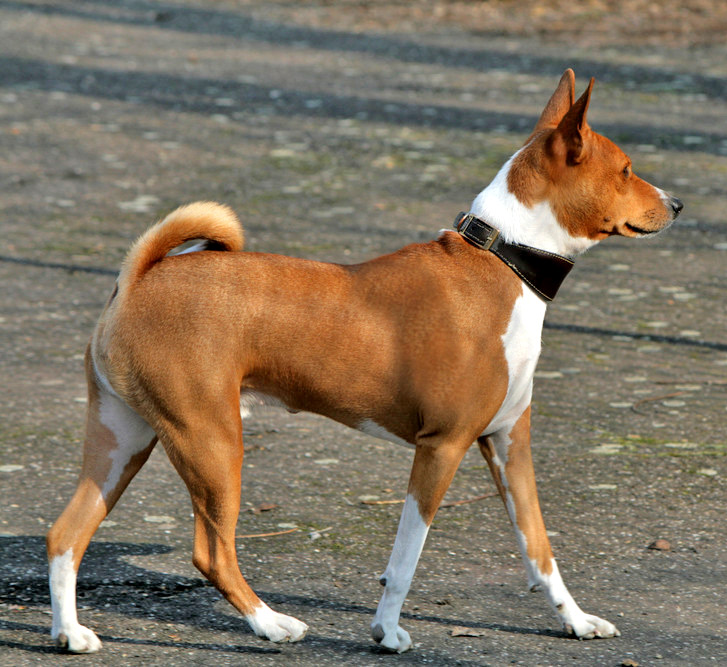
Basenjis have a short, fine, single coat that lies close to the body. There is no undercoat, no feathering, no furnishings. In terms of coat structure, this is about as simple as it gets.
But simple does not mean invulnerable. That short coat offers minimal protection against environmental factors:
- Sun exposure can cause skin damage, especially in lightly pigmented areas
- Dry winter air leads to flaky, irritated skin
- Allergens sit directly on the skin with very little coat barrier
- Insects have easy access to the skin surface
What a Professional Basenji Grooming Session Looks Like
Basenji grooming is faster than most breeds. A typical session runs 30 to 45 minutes:
- Bath with gentle shampoo -- the Basenji's skin is more exposed than heavily coated breeds, so a mild, moisturizing formula is important
- Blow dry -- quick with a short coat, but important for removing all moisture from skin folds
- Full body brush-out -- using a rubber curry brush or grooming mitt to remove dead hair and stimulate the skin
- Nail trim -- critical for this breed, typically every 3 to 4 weeks
- Ear cleaning -- removing wax and checking for debris
- Teeth check -- visual inspection for tartar buildup or gum issues
- Anal gland assessment -- checking and expressing if needed
- Skin inspection -- head-to-tail check for abnormalities
A Surprising Fact About Basenji Grooming
Here is one that catches most people off guard: despite being known as the "barkless dog" and the "self-cleaning dog," the Basenji actually sheds. Quite a bit, in fact, during seasonal transitions.
That short coat cycles through growth and rest phases just like any other breed. In spring and fall, Basenjis shed their coat more heavily as it adjusts for temperature changes. The individual hairs are short and fine, so they embed themselves in furniture, clothing, and carpet rather than forming visible clumps. Many Basenji owners think their dog does not shed because they do not see tufts of fur -- but run a lint roller over your couch and you will find plenty of evidence.
A professional grooming session during shedding season includes a thorough de-shedding treatment that removes significantly more dead coat than home brushing alone.
How Often Should You Bring Your Basenji In
Every 6 to 8 weeks is a good baseline for professional grooming. Some Basenji owners go every 4 weeks specifically for nail trims and skin checks, even if the coat itself does not need much attention.
Between professional visits, a weekly once-over with a grooming mitt or rubber curry brush keeps the coat smooth and stimulates healthy skin oil production. Honestly, that five-minute weekly session is about all the home grooming a Basenji needs.
Why Basenjis Actually Benefit More From Grooming Than You Would Expect
The irony of the Basenji is that its low-maintenance coat makes owners complacent. The dog looks and smells fine, so grooming gets pushed to the bottom of the priority list. Meanwhile, nails grow too long, skin issues develop quietly, and ear wax builds up.
Professional grooming for a Basenji is less about the coat and more about the full-body health check that comes with it. Think of it as a wellness visit that also happens to include a bath.
PawOps helps grooming salons provide the right level of care for every breed -- from high-maintenance coat work to the health-focused sessions that short-coated breeds like the Basenji need.