Understanding Your Field Spaniel's Coat: What Every Owner Should Know
Understanding Your Field Spaniel's Coat: What Every Owner Should Know
The Field Spaniel's coat is one of the most elegant in the entire sporting group -- a single layer of silky, moderately long hair that flows naturally and gleams when healthy. It is also one of the most misunderstood. Many owners expect the Field Spaniel coat to behave like a Cocker Spaniel's or an English Springer's, but it is a distinctly different coat with its own set of rules.
Let us get into what your Field Spaniel is actually wearing and how to care for it properly.
Single Coat vs. Double Coat: Why It Matters
The most important thing to understand about Field Spaniels is that they have a single coat. Most sporting breeds -- Labradors, Golden Retrievers, Springer Spaniels -- have double coats with a soft, dense undercoat beneath a coarser outer layer. Field Spaniels skipped the undercoat entirely.
What this means in practice:
- Less shedding compared to double-coated breeds. You will still find hair on your clothes, but it will not be the tumbleweeds-across-the-floor situation.
- Less insulation. Without an undercoat, Field Spaniels are more sensitive to temperature extremes. They feel cold faster in winter and have less thermal protection in summer sun.
- Different matting behavior. When tangles form, they sit directly against the skin. There is no undercoat buffer. This makes mats more uncomfortable and potentially more damaging to the skin underneath.
- Faster drying time. A single coat dries significantly faster than a double coat, which is a genuine plus for bath time and post-rain walkdowns.
The Coat Layer by Layer
The Main Body Coat
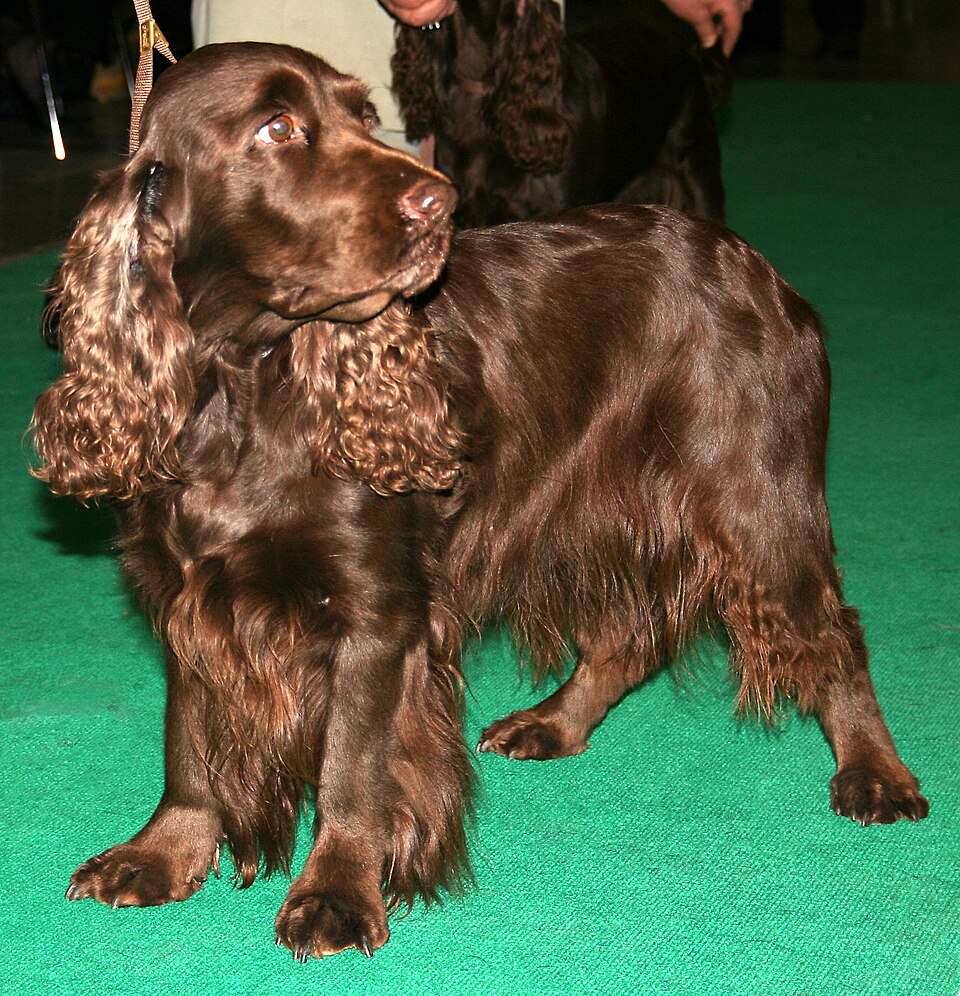
The Field Spaniel's body coat is flat to slightly wavy, silky in texture, and moderate in length. It should lie close to the body and have a natural sheen. The breed standard calls for a coat that is "glossy and silky in texture" -- and when a Field Spaniel coat is in good condition, it genuinely glows.
The body coat is self-maintaining to a degree. It does not grow continuously like a Poodle's coat, so it does not require haircuts in the traditional sense. It reaches a natural length and stays there, shedding and replacing individual hairs gradually.
The Feathering
This is where the maintenance demand lives. Field Spaniels grow longer, finer feathering on:
- Ears: Heavy, long feathering that frames the face
- Chest: A modest ruff of longer hair
- Belly: Softer, finer hair that hangs downward
- Backs of the legs: Feathering from thighs to hocks
- Feet: Hair between and around the toes and pads
- Tail: Moderate feathering along the underside
Color and Markings
Field Spaniels come in solid colors -- black, liver, golden liver, or roan patterns. Some have tan markings. Unlike many spaniel breeds, the breed standard does not allow large white patches. The solid coloring makes the coat's condition very visible -- a healthy Field Spaniel coat has depth and shine that is immediately obvious, and dullness shows just as quickly.
How the Coat Changes Through Life
Field Spaniel coats are not static. They evolve as your dog matures.
Puppy coat (birth to ~8 months): Softer, shorter, and easier to manage. Minimal feathering. Shedding is light. This is the deceptively easy phase that tricks new owners into thinking the breed is low-maintenance.
Adolescent transition (8-18 months): The adult coat starts growing in. Feathering gets longer and denser. The coat texture may shift from soft and fluffy to silky and flat. During this transition, tangling increases because the puppy coat and adult coat have different textures that catch on each other.
Adult coat (18 months+): Full feathering development. The coat reaches its characteristic length and silky texture. Shedding stabilizes into a moderate, year-round pattern with slight seasonal increases.
Senior changes (8+ years): Some Field Spaniels develop a drier, coarser coat texture as they age. Feathering may thin. The coat may lose some of its natural sheen. Adjusting to a more moisturizing grooming routine helps maintain comfort and appearance.
A Surprising Coat Fact
Here is something that surprises most Field Spaniel owners: the breed's coat texture is significantly affected by diet. A 2019 study in the Journal of Animal Physiology and Animal Nutrition found that omega-3 and omega-6 fatty acid supplementation improved coat gloss by measurable degrees in single-coated breeds. Field Spaniel breeders and experienced owners consistently report that dogs on high-quality diets with adequate fat content have noticeably silkier, shinier coats than dogs on budget food. If your Field Spaniel's coat looks dull despite good grooming, look at the food bowl before the shampoo bottle.
Common Coat Problems in Field Spaniels
Matting Hotspots
The top five matting locations on a Field Spaniel, in order of frequency:
Checking these five spots with a steel comb every other day takes about three minutes and prevents most matting problems before they start.
Ear Issues
The heavy ear feathering creates reduced airflow to the ear canal. Moisture gets trapped, warmth builds up, and infections follow. The Veterinary Information Network reports that pendant-eared sporting breeds have ear infection rates two to three times higher than erect-eared breeds. Keeping the feathering around the ear canal thinned and the canal itself clean is critical preventive care.
Static and Winter Dryness
Single-coated dogs are more prone to static buildup and dry coat issues in winter. Indoor heating reduces humidity, and the coat becomes flyaway, brittle, and prone to breakage. A light leave-in conditioning spray and a humidifier in the dog's primary living area both help.
Sun Exposure
Without an undercoat for protection, Field Spaniels with lighter liver or golden coloring can experience sun-related coat bleaching and, in extreme cases, skin sensitivity. If your dog spends significant time outdoors in strong sun, be aware that the coat may lighten and the skin underneath may need protection in thinly-coated areas.
Your Home Care Toolkit
Essential tools for Field Spaniel coat care:
- Pin brush or slicker brush: Everyday brushing for the body coat
- Steel comb: Checking feathering for hidden tangles
- Detangling spray: Apply before brushing to reduce breakage on the silky coat
- Ear cleaning solution: Weekly ear maintenance
- Conditioning spray: Light leave-in conditioner for coat health, especially in dry weather
- Thinning shears (optional): For experienced owners who want to maintain feathering between professional visits
A Practical Brushing Routine
Here is a routine that works for most Field Spaniels:
Every other day (10-15 minutes):
Weekly (5 minutes):
This routine, paired with professional grooming every five to seven weeks, keeps a Field Spaniel's coat in excellent condition year-round.
When the Coat Tells You Something Is Wrong
Pay attention to these coat signals:
- Sudden dullness: Could indicate dietary issues, illness, or stress
- Excessive shedding: May signal thyroid problems, allergies, or hormonal changes
- Coat texture changes: Coarsening or brittle texture warrants a vet check
- Patches of thinning: Possible allergic reaction, fungal infection, or autoimmune condition
- Oily or greasy feel: Could indicate sebaceous gland issues
PawOps helps grooming salons assess single-coated sporting breeds using condition scoring and coat analysis, ensuring your Field Spaniel receives care tailored to their specific coat needs -- not a generic sporting breed approach.
Related Reading: