Understanding Your Kerry Blue Terrier's Coat: What Every Owner Should Know
Understanding Your Kerry Blue Terrier's Coat: What Every Owner Should Know
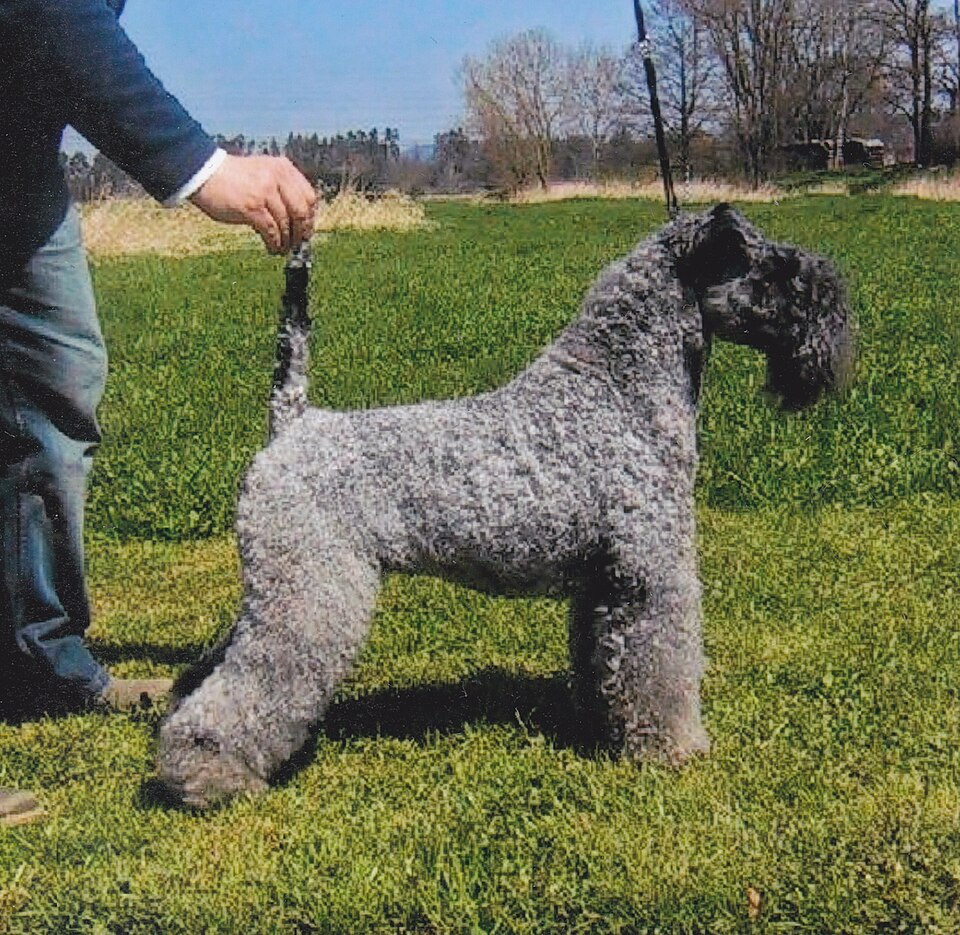
If you own a Kerry Blue Terrier, you own one of the most visually dramatic coats in the dog world. That soft, dense, wavy blue-gray is unlike anything else. But the kerry blue terrier coat has some surprising characteristics that every owner should understand to keep it looking and functioning at its best.
The Color Transformation
Let's start with the most dramatic feature: Kerry Blue Terriers are born black.
Not dark blue. Not gray. Solid black. Every single one.
Over the first 18 months to 3 years of life, the coat gradually transitions from black to the breed's signature blue-gray. This process is called "clearing," and it's driven by the progressive graying gene — the same gene found in Bedlington Terriers and some Poodle lines.
The clearing process happens at different rates for different dogs. Some Kerry Blues start showing blue tones by 9 months. Others still look quite dark at 2 years. The AKC breed standard allows Kerry Blues up to 18 months old to be shown in darker coats, acknowledging that the transition takes time.
The final shade varies too. Some Kerry Blues mature to a light silver-blue. Others settle into a deeper slate blue. A few maintain a very dark blue that's just barely distinguishable from black. All of these are within the breed standard.
Here's a detail breeders often share: you can sometimes predict the adult color by looking at the roots. If you part the coat on a young Kerry Blue and see lighter hair at the base, the clearing is underway even if the outer coat still looks dark.
Single Coat, Not Double
Unlike most terrier breeds, the Kerry Blue has a single-layer coat. There's no undercoat — just one dense layer of soft, wavy hair.
This matters for several practical reasons:
Temperature regulation: Without an insulating undercoat, Kerry Blues are more sensitive to extreme cold than double-coated breeds. In winter, the coat provides some protection, but it's not the thermal barrier that a Husky or even a Norwich Terrier has.
Shedding: Single-coated breeds don't go through the dramatic seasonal coat blows that double-coated breeds experience. The Kerry Blue's hair grows continuously and falls out minimally — good news for your furniture, but it means the coat needs regular cutting to stay manageable.
Matting patterns: Without an undercoat to create density near the skin, Kerry Blue mats tend to form as interlocked waves rather than the dense felt-like mats you see in undercoated breeds. These wave-mats can cover large areas quickly.
Drying time: The single coat actually absorbs water readily. A wet Kerry Blue takes significant drying time — 30-45 minutes with a high-velocity dryer for a full-coated dog. Incomplete drying leads to that damp-dog smell and increases matting risk.
Texture and What It Tells You
The ideal Kerry Blue coat texture is soft, dense, and wavy — not wiry, not curly, and definitely not straight and flat.
You can read your Kerry Blue's coat condition through texture:
- Soft and springy with a defined wave: Coat is in good condition. Keep doing what you're doing.
- Excessively soft and limp: Coat may be over-conditioned or the dog may have a nutritional issue. Check bathing products and diet.
- Harsh or wiry feeling: Unusual for a Kerry Blue. Could indicate a mixed coat texture (genetic variation) or excessive dryness. Consult your groomer.
- Tight curls instead of waves: The coat is overdue for grooming. As Kerry Blue hair grows longer, the wave tightens toward curl. Time for a trim.
- Flat and lifeless: Potential health concern. Can indicate thyroid issues, poor nutrition, or other systemic problems.
How Fast the Coat Grows
Kerry Blue coats grow at approximately half an inch per month — roughly the same rate as human hair. But because the coat is dense and wavy, length gain creates disproportionate volume.
A freshly groomed Kerry Blue looks sleek and structured. By week 3-4, the coat starts looking softer and fuller. By week 5-6, the outline is noticeably rounder and the defined lines of the trim are blurring. By week 8+, you're looking at a fluffy blue cloud that bears minimal resemblance to the post-groom look.
This growth rate is why the 4-6 week grooming schedule exists. It's not arbitrary — it's matched to how quickly the coat outgrows its shape.
Problem Areas to Watch
Every Kerry Blue has predictable trouble spots:
The beard: Collects food, water, and outdoor debris daily. Wipe it after meals. Comb it every time you brush the body. The beard mats faster than any other part of the coat.
Behind the ears: The soft hair here tangles against the ear leather. A few strokes with a comb during every brushing session prevents problems.
Chest and undercarriage: Movement and friction from lying down create tangles. Check this area during every brushing session.
Leg furnishings: The longer hair on the legs picks up burrs, mud, and debris during walks. A quick comb-through after outdoor time prevents matting.
Inside the ears: Dense hair grows inside the ear canal. This hair traps moisture and wax, creating an environment for bacterial and yeast infections. Your groomer should remove this hair regularly. Between grooms, an ear cleaning solution used weekly helps keep things dry and healthy.
Home Care Protocol
Here's the home care routine that keeps your Kerry Blue in shape between professional grooms:
Every other day (15-20 minutes):
- Line brush the body with a slicker brush — work in sections, lifting the coat and brushing from the skin outward
- Comb through the beard, legs, and behind the ears with a metal comb
- Quick check for any tangles forming
- Clean ears with a vet-approved solution
- Wipe the eye area to prevent staining
- Check between toes for matting or debris
- Trim paw pad hair if overgrown
- Check nail length
- Assess overall coat condition — if the wave is tightening to curl and the shape is lost, it's time for the groomer
Nutrition and Coat Quality
What your Kerry Blue eats shows up in their coat. A diet rich in omega-3 and omega-6 fatty acids promotes coat health from the inside. Studies in canine nutrition have shown that dogs on diets supplemented with fish oil show measurable improvements in coat density and sheen within 8-12 weeks.
Look for foods that list whole protein sources first, include fish or fish oil, and avoid excessive grain fillers. If the coat looks dull despite proper grooming, a dietary adjustment may be the missing piece.
Your Kerry Blue Terrier's coat is a living statement of breed character. Understand how it works, maintain it with care, and it'll reward you with that gorgeous blue-gray wave that makes this breed impossible to ignore.
---
Ready to streamline your grooming workflow? PawOps Board Manager helps salons track every Kerry Blue Terrier from check-in to pickup with real-time visibility. Start your free 30-day trial →
Related Reading: