Understanding Your Spanish Water Dog's Coat: Curls, Cords, and the Choice Between Them
Understanding Your Spanish Water Dog's Coat: Curls, Cords, and the Choice Between Them
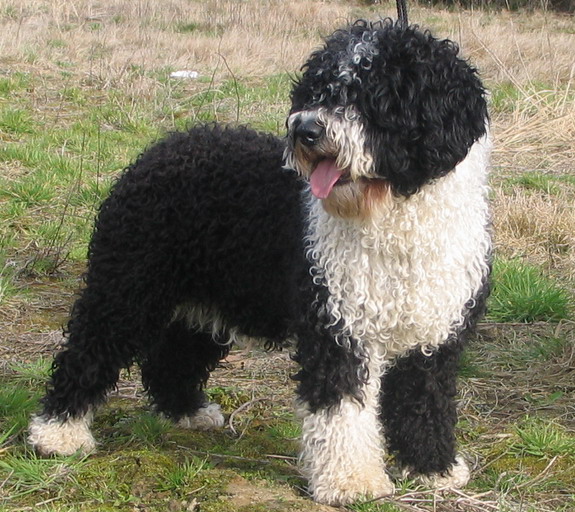
The Spanish Water Dog's coat is unlike any other breed's -- and understanding it requires throwing out almost everything you know about dog coat care. Do not brush it. Do not condition it. Do not style it. This is a coat designed to form natural cords, function in water, and maintain itself with minimal human intervention beyond periodic clipping.
Here is what you need to understand.
Coat Structure: Single, Curly, and Self-Cording
The SWD has a single-layer, wool-like coat with these characteristics:
- Single coat: No undercoat (or extremely minimal). This makes it different from double-coated curly breeds like the Lagotto.
- Wool texture: Dense, crimped, slightly coarse. More like sheep's wool than dog fur.
- Naturally cording: When left to grow, the curls interlock and form rope-like cords on their own -- no human intervention needed to initiate the process.
- Non-shedding: Hair does not fall out; it stays in the coat structure.
- Continuously growing: No terminal length.
The SWD coat is designed to form cords. The Lagotto coat is designed to remain as separate curls. The Poodle coat is designed to be sculpted. These are fundamentally different coat behaviors despite superficial similarity. Treating an SWD coat like a Lagotto or Poodle coat is incorrect and will cause problems.
The Natural Cord Formation Process
As an SWD's coat grows past 2-3 inches, the curls begin interlocking:
This process happens naturally without any human intervention. The owner's role is SEPARATION -- ensuring cords form as individual strands rather than merging into large mats.
Cord characteristics in SWDs:
- Thinner and more flexible than Komondor or Puli cords
- Approximately pencil to finger-width when mature
- Form fastest on the back, sides, and rear
- Form more slowly on legs and head
- Density varies by individual -- some dogs form very tight cords, others looser
The "Never Brush" Rule
The breed standard states the coat should never be brushed. Here is why:
- Brushing destroys cord formation -- it separates the interlocking curls that are trying to form cords
- Brushing creates frizz -- the wool-like texture poofs out when brushed, losing its natural structure
- Brushing is unnecessary -- the coat maintains itself through cord formation. Mats in an SWD usually mean cords that merged and need hand-separation, not brushing
- The breed aesthetic requires natural texture -- a brushed-out SWD looks like a different dog (puffy, undefined, not breed-typical)
The Annual Clip Tradition
Traditionally, Spanish Water Dogs are clipped once or twice annually:
- Allow the coat to grow for 8-12 months
- Clip the entire body uniformly to 1/4 - 1/2 inch
- Allow regrowth to begin the cycle again
- Shepherds clipped their dogs when they clipped their sheep
- A fresh short coat in spring kept dogs cool for summer work
- The annual reset prevented excessive cord weight and allowed skin inspection
Color Varieties and Coat Behavior
SWDs come in:
- Solid black (most common)
- Solid brown (chocolate)
- Solid white
- Black and white (particolor)
- Brown and white (particolor)
- Brown coats may feel slightly softer in texture than black coats
- White areas sometimes cord slightly differently than pigmented areas (the absence of melanin marginally affects hair structure)
- Sun exposure fades brown coats over time and can yellow white coats
- Particolor dogs may have slightly different cord thickness in white vs. pigmented areas
Water and the SWD Coat
This is a water dog. The coat was designed for aquatic work:
In water:
- The wool-like texture provides buoyancy
- Cords do not weigh the dog down (they are hollow-centered when properly formed)
- The coat repels some water initially, then saturates
- Post-swim, the dog shakes and the cord structure helps shed water
- A fully corded SWD takes 12-48 hours to air-dry completely
- Damp cords held against the body in warm weather can develop mildew odor
- After swimming, cords should be wrung out by hand and the dog kept in warm, ventilated conditions
- Professional forced-air drying cuts the time to 45-90 minutes for a fully corded dog
Matting vs. Cording: The Distinction
This is crucial to understand:
Cords: Intentional, organized, rope-like formations. Individual cords separated from each other. Skin visible at the roots between cords. The dog is comfortable.
Mats: Unintentional, disorganized, sheet-like formations. Multiple cords or areas of coat merged into a solid mass. Skin pulled tight underneath. The dog is uncomfortable.
The difference:
- Cords can be separated and maintained
- Mats must be cut or shaved out
- Regular hand-separation (splitting growing cords apart before they merge) prevents matting
- Neglected cords that are never separated WILL merge into mats over time
Climate Considerations
Developed in Spain's varied climate (hot summers, mild winters), the SWD handles temperature well:
- Summer: The coat provides sun protection. A freshly clipped dog needs caution in direct sun (no coat barrier). A corded dog stays cool because cords create airflow channels.
- Winter: The single coat provides moderate insulation. In very cold climates (below 30 degrees F), a coat or sweater helps, especially on freshly clipped dogs.
- Humidity: The coat handles humidity well -- cord formation actually works better in moderate humidity than extreme dryness.
- Dry climates: Very dry conditions can make the coat brittle. Occasional very light moisture helps.
Home Management Basics
For corded dogs (daily, 5-10 minutes):
- Run hands through the coat feeling for cords that are merging
- Separate any joining cords by hand (pull apart gently at the root)
- Check skin between cords for irritation
- After swimming: wring out cords, ensure adequate drying conditions
- Run hands over the body feeling for tangles
- Separate any starting tangles by hand (fingers, not brush)
- Check ears for moisture or debris
- Never brush
- Never use conditioner (softens the wool structure, prevents proper cord formation)
- Use minimal shampoo (diluted, gentle)
- Dry thoroughly after bathing
- Clip uniformly when trimming -- no shaping or styling