Understanding Your Portuguese Water Dog's Coat: What Every Owner Should Know
Understanding Your Portuguese Water Dog's Coat: What Every Owner Should Know
The Portuguese Water Dog coat is one of the most distinctive in the dog world -- and one of the most misunderstood. New Portie owners often focus on the "hypoallergenic" selling point without fully grasping what that coat actually requires. Once you understand how it works, why it behaves the way it does, and what it needs from you, life with your Portie gets a lot simpler.
Curly vs. Wavy: The Two Coat Types
Portuguese Water Dogs come in two distinct coat types, and knowing which one your dog has changes how you care for it:
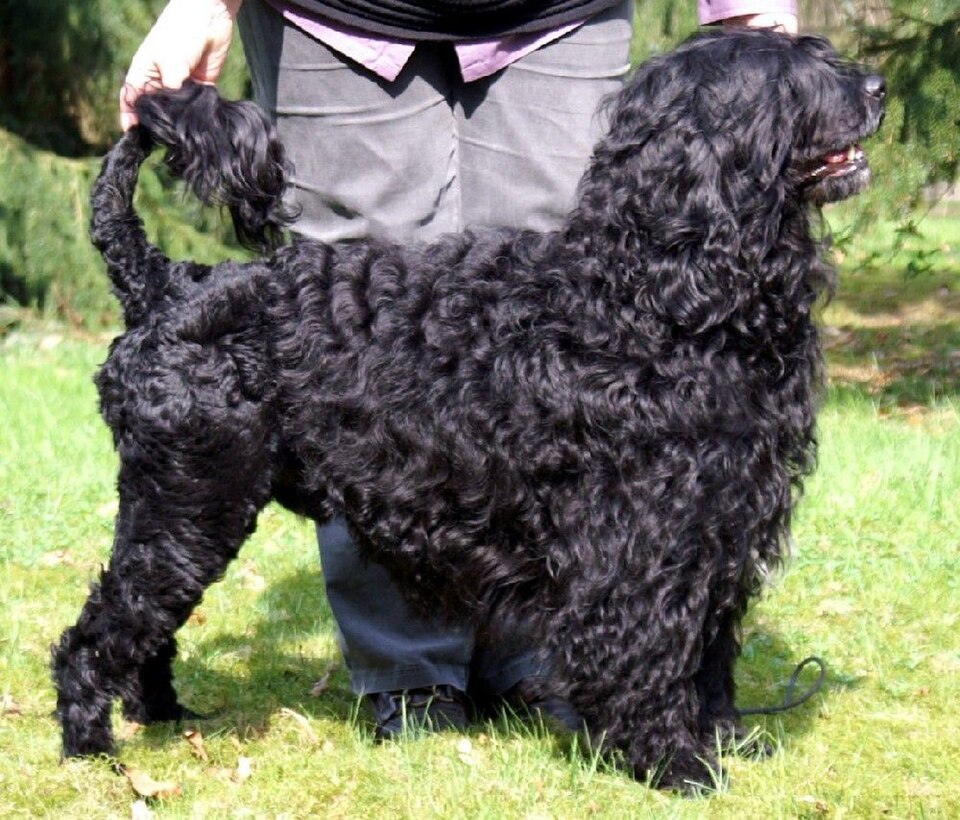
Curly coat: Dense, tight, cylindrical curls that cover the entire body. The texture is similar to a Poodle's coat -- springy, compact, and close to the body. Curly coats tend to mat faster because the curls interlock with each other, creating tangles close to the skin that are hard to see from the surface.
Wavy coat: Longer, looser waves that fall more naturally. Wavy coats have a slight sheen that curly coats don't. They're generally considered a bit easier to brush because the waves don't lock together as aggressively. However, wavy coats can develop mats in friction zones -- behind ears, under the collar, armpits -- just as easily.
Here's a surprising fact: Portuguese Water Dog puppies often don't show their final coat type until they're 12-18 months old. A puppy that looks wavy at 4 months might tighten into curls by age 2, or a curly-looking pup might relax into waves. The coat transition can catch new owners off guard because their grooming routine suddenly needs adjusting.
Both coat types are single-coated, meaning there's no undercoat beneath the outer hair. This is the key feature that makes Porties low-shedding.
Why the Portie Coat Is "Hypoallergenic" (Sort Of)
Let's clear something up: no dog is 100% hypoallergenic. What Portuguese Water Dogs are is significantly less allergenic than most breeds. Here's why:
No undercoat means less shedding. Double-coated breeds constantly cycle through their undercoat, releasing loose hair and dander into the environment. Porties don't have this second layer. Hair that loosens stays trapped in the surrounding curls or waves instead of floating onto your couch and into the air.
The coat traps dander. Those curls and waves act as a filter, capturing dead skin cells (dander) instead of releasing them into the air. This means less airborne allergen exposure -- though you're still exposed when you brush or pet the dog.
They produce less dander overall. Studies on dog allergenicity suggest that individual dogs vary more than breeds as a whole, but Portuguese Water Dogs consistently test at lower dander production levels than average.
The practical takeaway: Porties are a better choice for allergy sufferers, but "hypoallergenic" doesn't mean "zero maintenance." The same coat features that reduce allergens also mean the coat needs more hands-on care to stay healthy.
How the Portie Coat Grows
This is the single most important thing to understand about your Portuguese Water Dog's coat: it grows continuously, like human hair.
Most dog breeds have a growth cycle where hair reaches a predetermined length, stops growing, dies, and falls out. This is why a Labrador's coat stays roughly the same length year-round -- the hair has a built-in "stop" signal.
Portuguese Water Dogs don't have that stop signal. Their hair keeps growing until it's cut. Left ungroomed, a Portie's coat will grow several inches per year, becoming progressively harder to manage as length increases.
This growth pattern means:
- Regular haircuts are mandatory -- every 4-6 weeks
- Matting compounds over time -- longer coat tangles more easily than shorter coat
- The coat never stabilizes on its own -- there's no point where it just "settles"
- Grooming needs increase if you skip appointments -- it's not linear; difficulty increases exponentially with length
Coat Colors and Patterns
Portuguese Water Dogs come in several colors, and color can subtly affect coat management:
- Black -- The most common color. Dense, rich black. Coat texture tends to be on the thicker side. Shows dander and lint more visibly.
- White -- Less common. Stains more easily, especially around the mouth and eyes. Tear staining is more visible and may need extra cleaning.
- Brown -- Ranges from chocolate to café au lait. Brown coats sometimes have a slightly softer texture than black coats and may lighten with sun exposure.
- Black and white / Brown and white -- Parti-colored coats. The white sections may have slightly different texture than the colored sections, which can affect how tangles form.
Common Portuguese Water Dog Coat Problems
Matting
This is the Portie owner's constant battle. Mats form when loose hair that would normally shed gets trapped in the surrounding coat. They start small and tighten over time, eventually pulling on the skin and causing discomfort.
Mat hot spots on a Portie:
- Behind the ears
- Under the front legs (armpits)
- Behind the rear legs
- Under the collar or harness
- Around the groin area
- Between the toes
Coat Texture Changes
Several things can alter your Portie's coat texture:
- Spaying/neutering -- hormonal changes can soften the coat or alter the curl pattern
- Clipping vs. hand-scissoring -- repeated close clipping can change texture over time
- Age -- senior Porties often develop softer, finer coats
- Diet -- poor nutrition shows up in coat quality fast
Moisture and Skin Issues
Porties love water -- it's literally in their name. But a dense, curly coat that stays damp is a breeding ground for hot spots and fungal infections. After swimming, a Portie needs to be dried thoroughly, including deep into the coat where moisture hides.
Professional high-velocity dryers reach moisture that towel-drying and air-drying miss. This is one of the less obvious but very practical reasons for regular professional grooming.
Caring for Your Portie's Coat at Home
Weekly Routine
- Brush 2-3 times per week with a slicker brush. Work in sections, parting the coat and brushing from skin outward.
- Follow with a metal comb to check for tangles the brush missed.
- Pay extra attention to friction zones -- armpits, behind ears, collar area.
- Check and clean ears weekly -- look for redness, odor, or excess wax.
Bathing at Home
Between professional grooms, you can bathe your Portie as needed:
- Use a quality shampoo formulated for curly coats
- Always condition after shampooing -- this reduces tangling significantly
- Dry thoroughly -- never let a Portie air dry completely; the dense coat holds moisture for hours
- Brush out after drying while the coat is clean and conditioned
Tools You Need
The Portie Coat as a Commitment
Owning a Portuguese Water Dog means accepting that coat care is part of the deal. It's not a once-in-a-while thing -- it's a weekly routine backed by monthly professional appointments. The reward is a beautiful, healthy, comfortable dog with one of the most distinctive coats in any breed.
The coat is part of what makes Porties special. Understanding it turns a potential source of frustration into something you can manage with confidence. And when that freshly groomed Portie bounces through the park with their curls looking perfect, you'll know exactly what went into making that happen.
---
Ready to streamline your grooming workflow? PawOps Board Manager helps salons track every Portuguese Water Dog from check-in to pickup with real-time visibility. Start your free 30-day trial →